
A no-nonsense, pastry-chef breakdown of what actually makes a cheesecake crack, sink, or turn out perfect.
I’ve watched more cheesecakes die in a home oven than I can count. Not from bad ingredients. Not from bad recipes, even. They die from small, invisible decisions made in the first ten minutes of mixing — decisions nobody tells beginner bakers about because they seem too obvious to mention.
So let’s mention them. This is the strawberry cheesecake I hand to anyone who tells me they’ve “never gotten cheesecake to work.” No water bath drama, no mystery cracks, no dense hockey puck pretending to be dessert. Just a recipe that respects what cheesecake actually is: a custard, not a cake, and it wants to be treated like one.
Before you preheat the oven, here’s what actually matters:
- Room-temperature cream cheese isn’t a suggestion — it’s the difference between silky and lumpy
- Overmixing after you add the eggs is the #1 cause of cracks, not oven temperature
- Frozen strawberries work fine for the topping; fresh is better if you’re folding them in raw
- Underbaking slightly and letting the cheesecake finish setting as it cools beats overbaking every time
- A wobble in the center when you pull it from the oven is correct, not a mistake
What You Actually Need (No Mystery Ingredients)
Cheesecake ingredient lists look intimidating because recipes love to dress them up. They shouldn’t. Here’s the entire cast of characters, and every one of them earns its place.
For the crust
- 2 cups graham cracker crumbs (about 14–16 full crackers, crushed)
- 6 tablespoons unsalted butter, melted
- 3 tablespoons granulated sugar
- Pinch of salt
For the cheesecake filling
- 4 blocks (32 oz total) full-fat cream cheese, at true room temperature
- 1 cup granulated sugar
- 1 cup sour cream, room temperature
- 1 tablespoon vanilla extract
- 3 large eggs, room temperature
- 2 tablespoons all-purpose flour
- 1 cup fresh strawberries, hulled and diced small
For the strawberry topping
- 2 cups strawberries, hulled and halved (fresh or frozen — see below)
- 1/3 cup sugar
- 1 tablespoon lemon juice
- 1 tablespoon cornstarch mixed with 2 tablespoons water
Notice what’s not on this list: gelatin, condensed milk, cream cheese substitutes, anything with the word “instant” in it. Full-fat cream cheese and sour cream are doing all the structural work here. Don’t swap them for lighter versions — this is one dessert where “light” ingredients genuinely sabotage the texture.
The Method (Where Most Recipes Get It Wrong)
Here’s the part nobody explains well: cheesecake filling is a custard. Custards set from gentle, even heat — not from being whipped into submission. Every step below exists to protect that gentleness.
Build the crust
Combine the crumbs, melted butter, sugar, and salt until it looks like wet sand. Press it firmly into the bottom of a 9-inch springform pan — use the flat bottom of a measuring cup to really compact it, since a loose crust crumbles the second you slice into it. Bake at 325°F for 8–10 minutes, then let it cool while you make the filling.
Mix the filling — and stop before you think you should
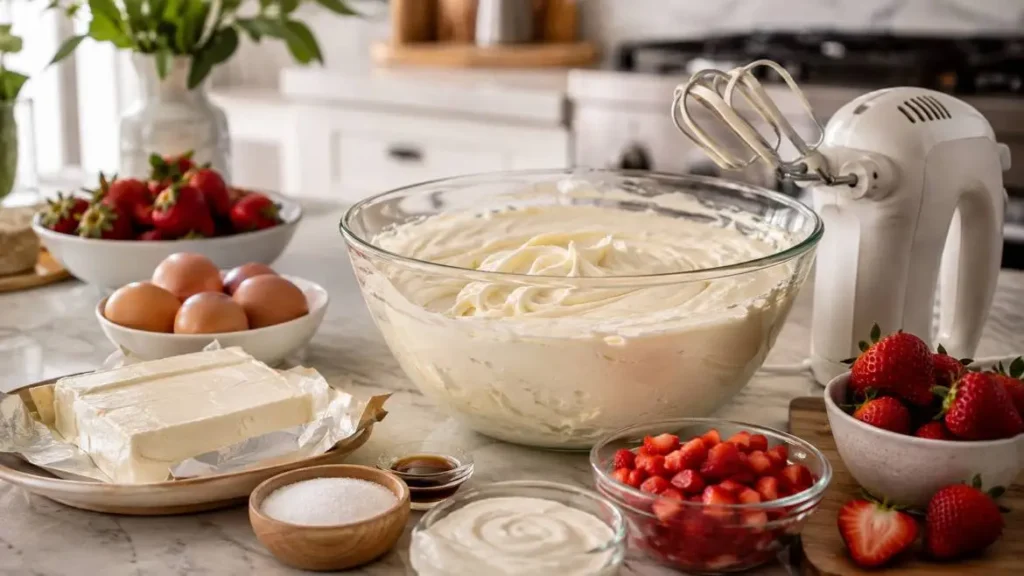
Beat the room-temperature cream cheese alone first, until it’s completely smooth with zero lumps. This step matters more than any other single instruction in this recipe. Cold cream cheese does not smooth out later; it just hides lumps under sugar until they show up in your finished slice.
Add the sugar, then the sour cream and vanilla, mixing on low each time. Then add the eggs one at a time, mixing only until each one disappears into the batter. This is the moment to put the mixer down. Overbeating after the eggs go in whips air into the batter, and that air is exactly what causes cheesecake to puff up in the oven and then crack as it deflates. Fold in the flour and diced strawberries by hand with a spatula.
Bake low, slow, and don’t peek
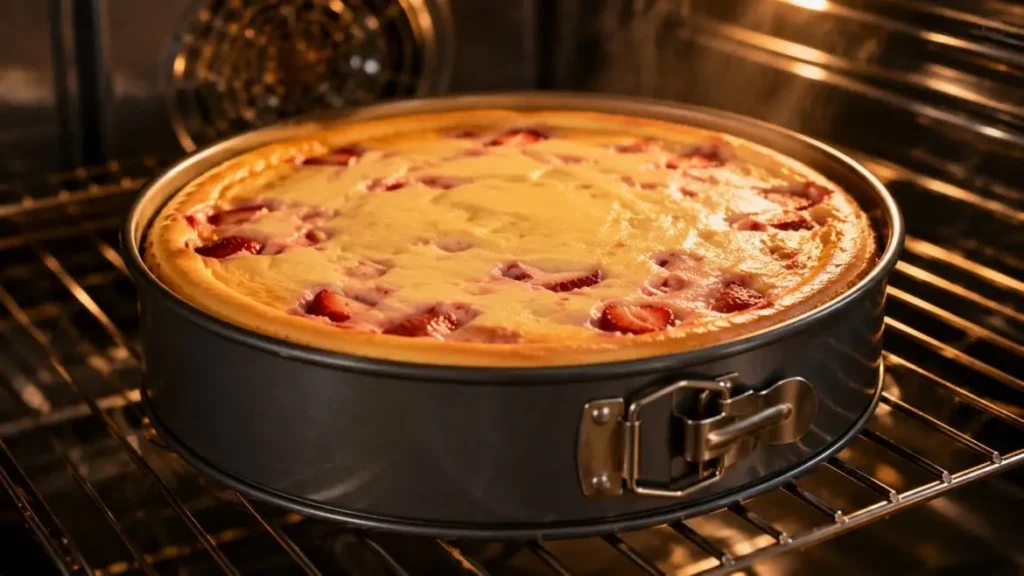
Pour the filling over the crust and bake at 325°F for 55–65 minutes. You’re looking for edges that are set and a center that still jiggles like gelatin, not liquid batter, when you nudge the pan. That wobble is correct — the residual heat finishes the job as it cools. Turn the oven off, crack the door, and let the cheesecake sit inside for an hour before moving it to the counter. This gradual temperature drop is what prevents the surface from cracking as it contracts.
Chill properly before you even think about slicing
Refrigerate uncovered for at least 6 hours, ideally overnight. I know the wait is brutal. Slice it too early and you get a cheesecake that’s set on the outside and soup in the middle — patience here isn’t optional, it’s structural.
Fresh Strawberries or Frozen? Here’s the Actual Answer
This depends entirely on what job the strawberries are doing. For the filling, use fresh, diced small, folded in gently at the very end — frozen berries release too much water into the batter and can throw off the set. For the topping, frozen strawberries are genuinely fine, sometimes even better, because commercially frozen berries are usually picked and frozen at peak ripeness, giving you more consistent flavor than an out-of-season “fresh” strawberry from the grocery store.
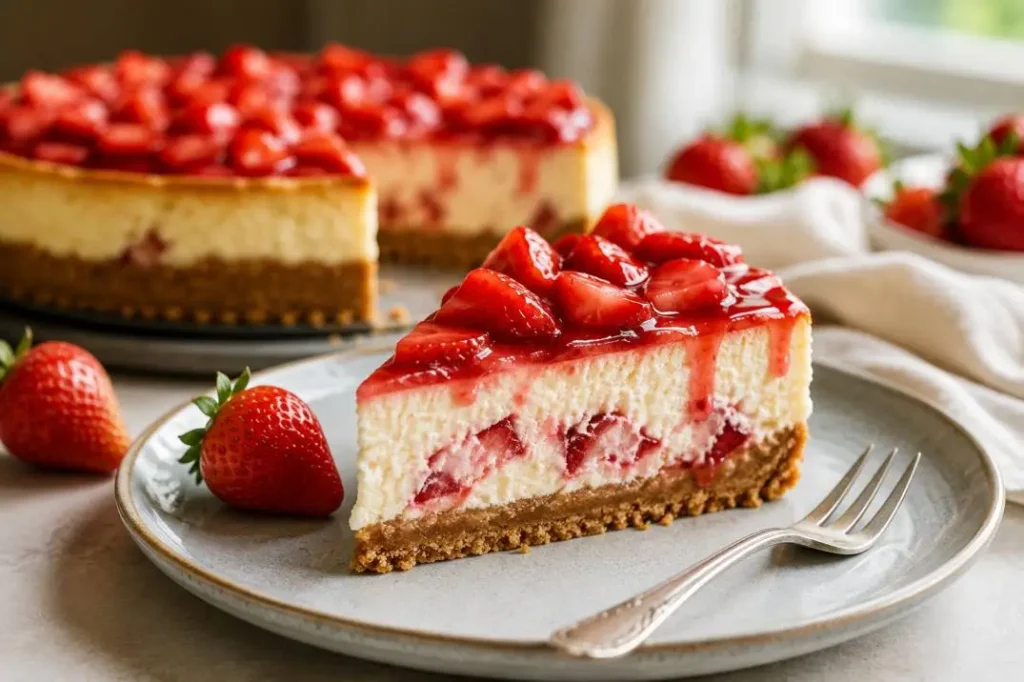
To make the topping: simmer the strawberries with sugar and lemon juice over medium heat until they break down slightly, about 8 minutes. Stir in the cornstarch slurry and cook another 2 minutes until glossy and thickened. Cool completely before spooning over the chilled cheesecake — a warm topping will melt into the surface instead of sitting on top.
The Mistakes That Actually Ruin Cheesecake
Most “cheesecake tips” lists are recycled nonsense about water baths. Water baths help, but they’re not why cheesecakes fail most often at home. These are:
- Cold ingredients. Cream cheese, eggs, and sour cream all need to be genuinely room temperature — not “sat out for ten minutes” temperature. Cold ingredients don’t emulsify properly, and you’ll fight lumps the entire way through.
- Overmixing after the eggs go in. This is the single biggest cause of cracked, sunken cheesecakes. Air whipped into the batter has to escape somewhere, and it escapes through the top as the cake bakes and cools.
- Overbaking. A cheesecake baked until it’s fully firm in the center is already overdone — it’ll be dense and dry by the time it’s fully chilled. Slight underbaking, with a jiggly center, is exactly right.
- Slicing while warm. Every bit of that beautiful set texture depends on a full, slow chill. Cutting in early undoes hours of careful baking in about four seconds.
Quick Answers to What Everyone Asks
Is cheesecake actually that unhealthy?
It’s a dessert made from full-fat dairy and sugar, so no, it’s not health food — but it’s also not uniquely villainous compared to any other rich dessert. A slice of this cheesecake isn’t meaningfully different, calorie-wise, from a slice of layer cake or a couple of cookies. Everything in moderation, cheesecake included.
What’s the actual secret to a good cheesecake?
If I had to boil this whole recipe down to one sentence: treat it like a custard, not a cake. Gentle mixing, gentle baking, gentle cooling. Every “secret” ingredient people chase — sour cream, a splash of flour, a water bath — is really just in service of that one principle.
How do you get that light, not-dense texture?
Room-temperature ingredients that blend smoothly without needing aggressive mixing, plus not overbaking. Dense cheesecake is almost always a mixing or baking-time problem, not a recipe problem.
Go Make This One
Cheesecake has a reputation as the dessert you order at a restaurant rather than attempt at home, and I get why — it looks fussy from the outside. It isn’t. It’s forgiving once you understand what it actually needs: warm ingredients, a light hand, and the patience to let it finish setting on its own terms rather than rushing it out of the oven and onto a plate.
Make this one on a weekend when you’re not in a hurry, let it chill overnight, and you’ll understand why I stopped ordering cheesecake at restaurants years ago.
Made this one?
I’d genuinely like to know how your crust held up and whether the center wobble talked you out of pulling it from the oven too early — that’s the step everyone second-guesses the first time. Drop a comment with how it turned out