
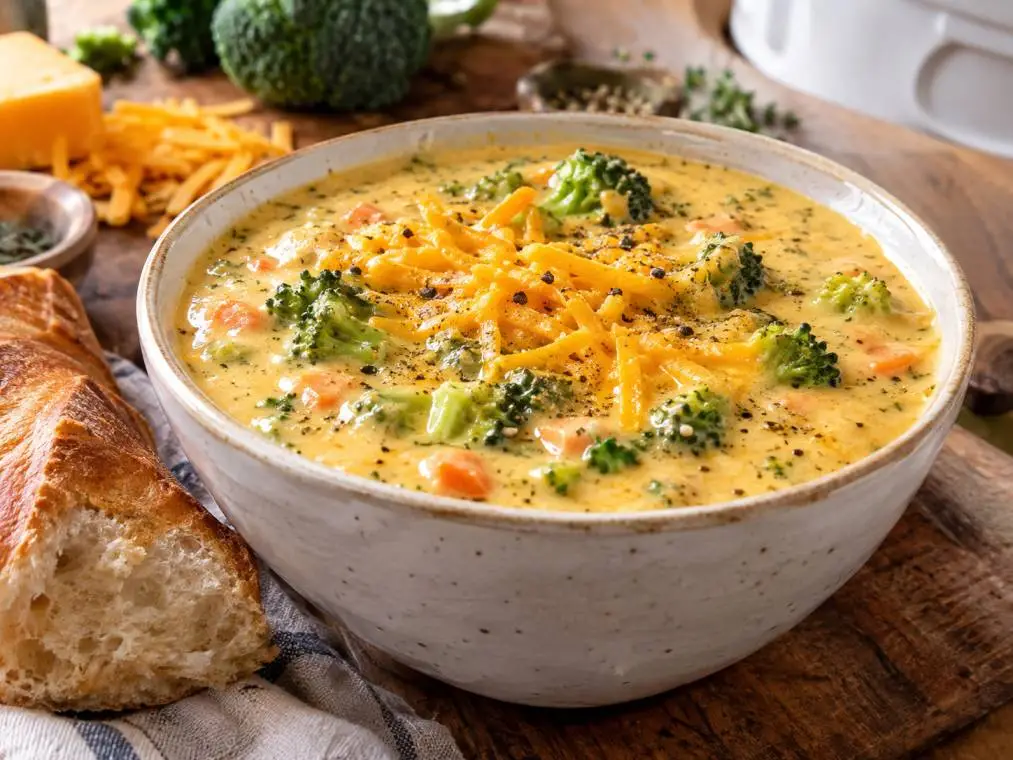
There’s a very specific kind of tired that hits around 5 p.m. on a weeknight — the kind where the idea of standing at a stove, stirring a roux, babysitting a pot so it doesn’t scorch, feels like a genuine ask too far. I’ve been there more times than I’d like to admit. That’s exactly the evening this soup was built for.
Broccoli cheddar soup is one of those recipes everyone loves but almost nobody makes at home, because the stovetop version has a reputation for being fussy — curdled cheese, gluey broccoli, a broth that never quite comes together. Throw it in the crockpot, though, and most of that fuss disappears. You dump, you walk away, you come back to something that tastes like it took a lot more effort than it did.
This is a from-scratch recipe, built specifically to answer the questions people actually search for when they’re staring at their slow cooker wondering if this is even going to work. Consider this your no-nonsense guide.
Key Takeaways
- Broccoli goes in later, not at the start — this is the single biggest fix for mushy, dull-tasting soup
- Skip pre-shredded cheese; it won’t melt smoothly and can leave your soup grainy
- Low and slow (4-6 hours on low) beats high heat for flavor, even though high works in a pinch
- A splash of acid at the end — lemon juice or a little Dijon — is the “secret ingredient” most versions leave out
- Dairy and cheese are added toward the end of cooking, never at the start, to avoid separating
Why the Slow Cooker Actually Makes This Soup Better
Here’s the thing about broccoli cheddar soup: on the stove, you’re fighting the clock the whole time. Cheese wants to break if it gets too hot too fast. Broccoli goes from crisp to grey-green mush in about four minutes if you’re not watching it. A crockpot removes almost all of that pressure because the heat is gentle and consistent — there’s no scorched bottom, no frantic whisking.
What it doesn’t remove is the need for a little strategy. Slow cookers are brilliant at coaxing flavor out of aromatics and building a rich broth base, but they’re not great at “gentle” once you introduce dairy or delicate vegetables. So the method that works best isn’t fully hands-off — it’s mostly hands-off, with two or three moments where you step back in.
The Broth Base
Chicken stock is the classic choice, and for good reason — it has enough body to carry the cheese without competing with it. Vegetable stock works fine if you want to keep things vegetarian, though I’d reach for one that’s roasted or “rich” style rather than a thin, watery one; broccoli cheddar soup lives or dies on how flavorful the base is before the cheese even goes in.
Original Crockpot Broccoli Cheddar Soup Recipe
A note before you dive in: this recipe was developed from scratch for this post and hasn’t been kitchen-tested yet, so treat quantities and timing as a strong starting point rather than gospel — I’d recommend a trial run before serving it to guests.
Ingredients
- 1 tbsp butter (for sautéing aromatics, optional but recommended)
- 1 small yellow onion, diced
- 2 cloves garlic, minced
- 3 medium carrots, shredded or finely diced
- 4 cups chicken stock (or rich vegetable stock)
- 1 tsp dry mustard powder
- 1/2 tsp smoked paprika
- Salt and pepper to taste
- 4 cups broccoli florets, cut small
- 1/3 cup all-purpose flour
- 1 cup whole milk or half-and-half
- 3 cups sharp cheddar, freshly grated (not pre-shredded)
- 1 tsp Dijon mustard or a squeeze of lemon juice
Instructions
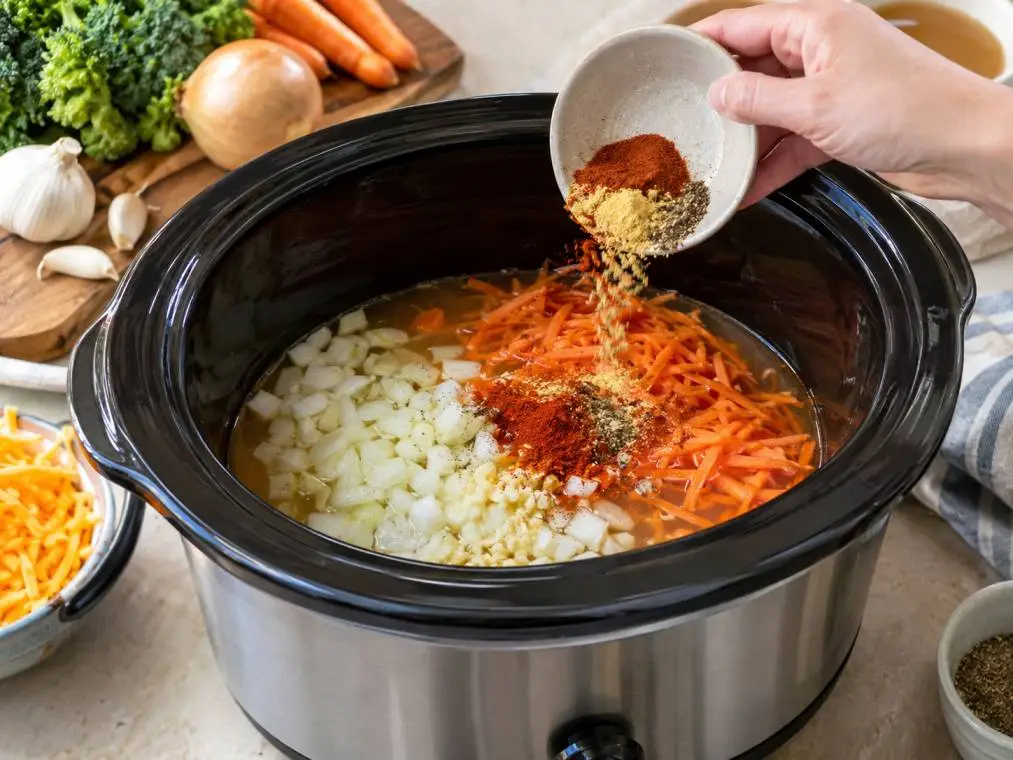
- If you have five extra minutes, sauté the onion, garlic, and carrots in butter until the onion turns translucent. This isn’t mandatory, but it builds a deeper flavor base than dumping everything in raw.
- Add the sautéed vegetables (or raw, if skipping step 1), stock, dry mustard, smoked paprika, salt, and pepper to the crockpot. Cover and cook on low for 3-4 hours, or high for 2 hours.
- Add the broccoli florets in the last 45 minutes to 1 hour of cooking. This is the step people skip, and it’s the reason so many broccoli cheddar soups taste like baby food — broccoli only needs a short window of gentle heat to cook through without going grey and bitter.
- In a small bowl, whisk the flour into the milk until smooth, then stir it into the crockpot about 20 minutes before serving. This thickens the soup without you needing a separate roux.
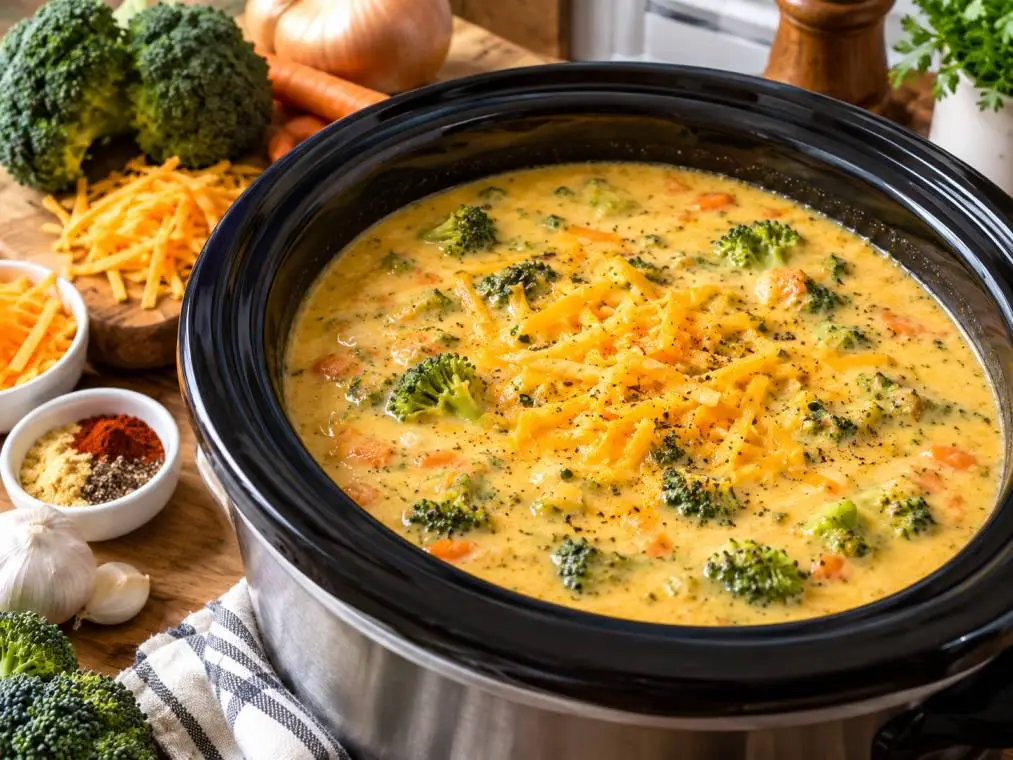
- Turn the crockpot off or switch it to warm. Stir in the grated cheddar a handful at a time, letting each addition melt before adding more. Adding cheese to residual heat rather than active high heat is what keeps it silky instead of grainy.
- Stir in the Dijon or lemon juice right at the end. Taste, adjust salt and pepper, and serve.
The “Secret Ingredient” Everyone’s Looking For
If you’ve searched around for what makes a broccoli cheddar soup taste like restaurant-quality instead of “fine, I guess,” the honest answer isn’t one dramatic ingredient — it’s a small dose of acid. A splash of lemon juice or a spoonful of Dijon mustard at the very end cuts through the richness of the cheese and cream, and it’s the difference between a soup that tastes flat and one that tastes bright and balanced.
Smoked paprika and dry mustard powder do quieter work in the background. Neither is detectable on its own, but together they round out the cheddar’s sharpness and keep the soup from tasting one-note. If you want to push it further, a small pinch of nutmeg is a classic (if unexpected) addition to cream-based vegetable soups — it won’t taste like nutmeg, it’ll just taste like the soup got better.
Common Mistakes That Wreck Broccoli Soup
Most disappointing broccoli soup comes down to one of a handful of avoidable missteps:
- Adding broccoli too early. Hours of slow cooking turns broccoli into something closer to a stain than a vegetable. Add it late.
- Using pre-shredded cheese. Bagged shredded cheese is coated in anti-caking agents that resist melting smoothly, which is exactly how you end up with a grainy, oily-looking soup instead of a glossy one.
- Boiling the soup after the dairy goes in. High, direct heat is what makes cream and cheese split. Once dairy is in, keep the heat low or off entirely.
- Skipping the acid. Without it, the soup can taste heavy and a little one-dimensional, no matter how good the cheese is.
- Under-seasoning the broth before the cheese goes in. Cheese and cream mute seasoning, so the broth should taste slightly bold on its own before you add either.
Wrapping It Up
Broccoli cheddar soup has a reputation for being either a restaurant treat or a kitchen headache, and honestly, neither has to be true. The crockpot strips out most of the stress — you’re just being deliberate about when the broccoli and dairy join the party. Get that timing right, use real grated cheese, and finish with a little acid, and you’ll have a soup that holds up next to the version you’d order in a bread bowl.
Give this one a try on your next slow-cooker night, and if you tweak it — more garlic, a handful of bacon, a swap to gouda — I’d genuinely love to hear how it turned out. Drop your version in the comments; some of the best changes to this recipe are going to come from someone else’s kitchen, not mine.
FAQ: Crockpot vs. Stovetop, Timing, and Common Slow Cooker Questions
Does soup taste better made in a slow cooker?
Not inherently better, but often more consistent. The low, steady heat is gentler on delicate ingredients and gives flavors more time to meld, which is especially noticeable in broth-based soups. The trade-off is control — you can’t taste and adjust mid-cook the way you can on the stove.
Which is better for cooking, a crockpot or the stovetop?
It depends what you’re optimizing for. Stovetop wins on speed and control; crockpot wins on convenience and hands-off cooking. For a cheese-based soup specifically, the crockpot’s gentler heat is genuinely an advantage, since it’s harder to accidentally scorch or split the dairy.
What are common mistakes to avoid when making crockpot vegetable soup?
The big ones: adding all vegetables at the start regardless of how delicate they are, over-salting early (flavors concentrate as liquid reduces), and lifting the lid frequently, which lets out heat and extends cooking time more than people expect.
How long should soup cook in a crockpot?
For a broth-based soup like this one, 3-4 hours on low or 2 hours on high gets the base fully cooked, with delicate additions like broccoli and dairy going in during the final stretch.
Can you overcook soup in a crockpot?
Yes. It’s slower to happen than on the stove, but vegetables can still turn mushy and dairy can still separate if it sits on active heat too long. Once dairy and cheese are stirred in, switching the crockpot to warm (or off) rather than leaving it on low is the safer move.
What foods should not be cooked in a slow cooker?
Dairy and cheese are the relevant ones here — they should go in near the end rather than cooking for hours, or they risk curdling and separating. More broadly, delicate seafood, pasta, and anything meant to stay crisp (like fresh herbs or leafy greens added for texture) also do better added late rather than cooked the whole time.